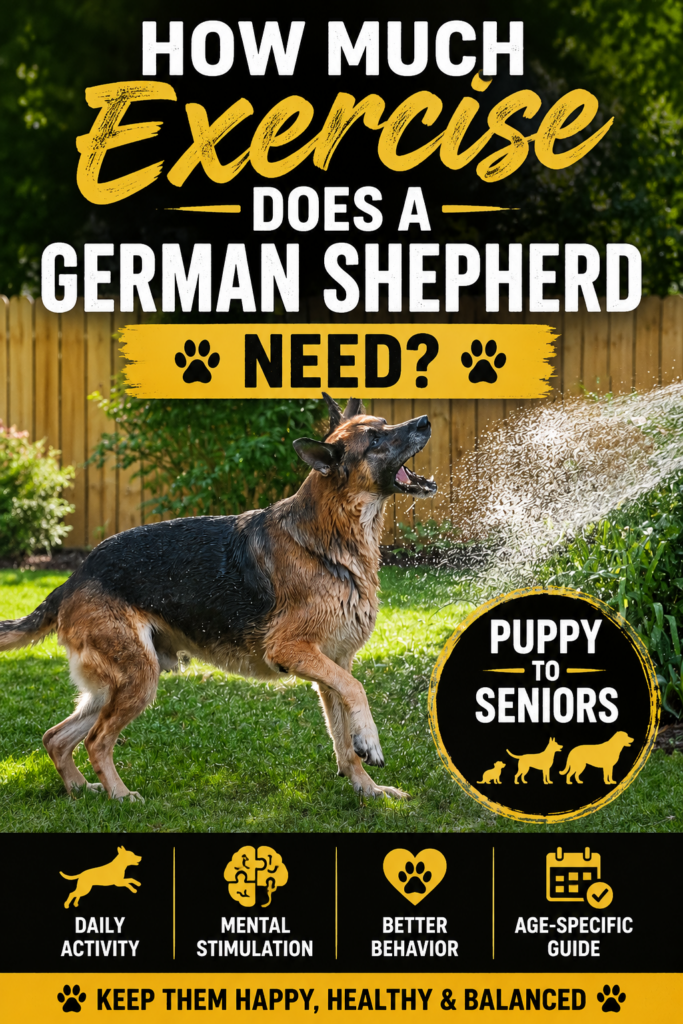
Zeus, my German Shepherd, is eleven now — and the honest answer to how much exercise a German Shepherd needs has changed more times than I can count. When people ask me how much exercise German Shepherds need, they usually want one tidy number. There isn’t one. It depends on age, on the individual dog, and on the day.
A tired German Shepherd is a good German Shepherd — but “tired” means something completely different at eleven than it did at two. Zeus used to come back from an hour of fetch looking for round two. These days a gentle sniff-walk and a swim leave him happily snoring by the fireplace. Let me walk you through what I’ve learned about German Shepherd exercise at every stage.
How Much Exercise Does an Adult German Shepherd Need?
German Shepherds are a high-drive working breed, and it shows. For a healthy adult, you’ll commonly see somewhere around 1 to 2 hours a day recommended — some sources say “at least 90 minutes.” I’d treat that as a range, not gospel. Zeus in his prime wanted every minute of it. I’ve also known GSDs from calmer lines who were content with less.
The good news is you don’t have to do it all in one marathon block. Split it across the day. A morning walk, a midday game of fetch, an evening training session — it all counts, and honestly it’s easier on your schedule too.
Here’s what worked for us for physical exercise:
- Brisk walks — the everyday backbone. A proper long training line gave Zeus room to explore without me losing control. long training line
- Running and fetch — great for burning energy, once a dog is fully grown.
- Swimming — my personal favorite, and I’ll come back to why.
- Dog sports — agility, tracking and scent work, herding. This is where GSDs truly light up.
A quick word on gear: a good no-pull harness saved my shoulders and made walks something we both enjoyed instead of a tug-of-war. no-pull harness
Don’t forget the brain. With this breed, mental exercise matters as much as the physical kind. A bored German Shepherd is a destructive German Shepherd — I learned that the hard way through a chewed baseboard. Scent games, puzzle feeders, training new commands, and the right chew toys can tire Zeus out faster than a long walk. If you want ideas, I’ve rounded up our favorites in The Best Toys for German Shepherds.
The Puppy “5-Minute Rule” — and Why I Take It With a Grain of Salt
If you’ve got a puppy, you’ve probably heard the 5-minute rule: roughly 5 minutes of structured exercise per month of age, up to twice a day, until the growth plates close. So a 4-month-old pup gets about 20 minutes a session.
Protect those growing joints. While a puppy is still growing, I avoid forced or long runs, repetitive jumping, and lots of stairs. Those soft growth plates are vulnerable, and I’d rather err on the side of gentle.
Now, the honest part — because I promised myself I’d always give you that. The 5-minute rule is a useful guideline, but it doesn’t have strong scientific proof behind it. And the age when growth plates actually close is genuinely disputed — you’ll see anywhere from around 14 to 24 months cited for large breeds. My rule of thumb is to limit high-impact activity through at least 18 months and confirm the timing with my vet, since every dog is different.
It’s also worth keeping this in perspective: most serious growth-plate injuries come from trauma — a fall, a car, a bad landing — not from a puppy walking a few extra minutes. And the single biggest thing you can do for a growing dog’s joints isn’t a magic exercise formula at all. It’s keeping them lean. Weight management matters most, at every age. Please talk to your vet about the right activity level and body condition for your specific puppy.
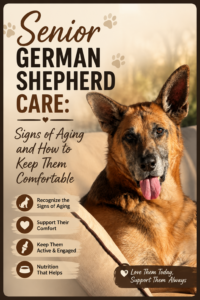
Senior German Shepherds: Shift to Low-Impact
This is the chapter Zeus and I are living now, so it’s close to my heart.
As a German Shepherd ages, the goal shifts from “burn energy” to “keep this body moving comfortably.” Go low-impact. Swimming has been a gift — it builds and maintains muscle without pounding the joints, and Zeus paddles around like he’s ten years younger.
Here’s how I structure senior exercise:
- Shorter, gentler, more frequent. Two or three easy outings beat one long slog.
- Always warm up first. Cold, stiff joints don’t like sudden effort.
- Watch for overexertion and temperature sensitivity. Older dogs tire faster and handle heat and cold poorly — I keep sessions short on hot or icy days.
- Skip the mid-air stuff. No leaping catches, no hard fetch with big landings.
Before you change a senior dog’s routine much, get vet clearance. Aging bodies sometimes hide problems that a checkup catches. There’s more on all of this in Senior GSD Care, and if you’re wondering what “old” even means for the breed, German Shepherd Lifespan digs into it.
Signs Your German Shepherd Isn’t Getting Enough
Under-exercised GSDs tell on themselves. Watch for:
- Destructive behavior (goodbye, baseboards)
- Weight gain
- Hyperactivity that won’t settle
- Excessive barking
- Stiffness
When Zeus was younger, a “bad behavior” week almost always turned out to be a “not enough exercise” week in disguise.
Aging Joints and Mobility: What to Watch For
Separate from simple under-exercise, keep an eye out for signs of actual joint trouble as your dog ages: a “bunny-hopping” gait (both back legs moving together), difficulty rising, reluctance on stairs, or limping. If you notice these, talk to your vet — these can point to conditions worth diagnosing early, and I’d never want you to guess.
A few tools have genuinely made Zeus’s daily life easier, and they may help your dog too:
- A dog ramp for the car and couch, so he isn’t jumping down onto hard joints. dog ramp
- Traction underfoot — non-slip rugs or paw grips turn a scary slick floor into a safe one. non-slip rugs or paw traction
- A support harness with a handle, for helping him up on stiff mornings. support harness
- An orthopedic dog bed for real rest between sessions — this was one of the best things I ever bought him. orthopedic dog bed
And I’ll say it one more time because it’s that important: keep your dog lean. Weight management is the single most protective factor for aging joints. No supplement, ramp, or bed does more.
The Real Answer
So — how much exercise does a German Shepherd need? Around 1 to 2 hours a day as a healthy adult, a few careful minutes as a puppy, and short gentle sessions as a senior. But the truest answer is the one Zeus taught me: watch the dog in front of you. He’s told me what he needs at every stage, if I was paying attention.
Lace up, grab the leash, and enjoy the walk. These are the good years — every single one of them.
Sources
- American Kennel Club: hip dysplasia in dogs
- American Kennel Club: swimming for senior dogs
- PetMD: signs your dog is not getting enough exercise
Heads up: some links below are affiliate links, and I may earn a small commission if you buy through them — at no extra cost to you. I only point to gear I’d actually put under Zeus.