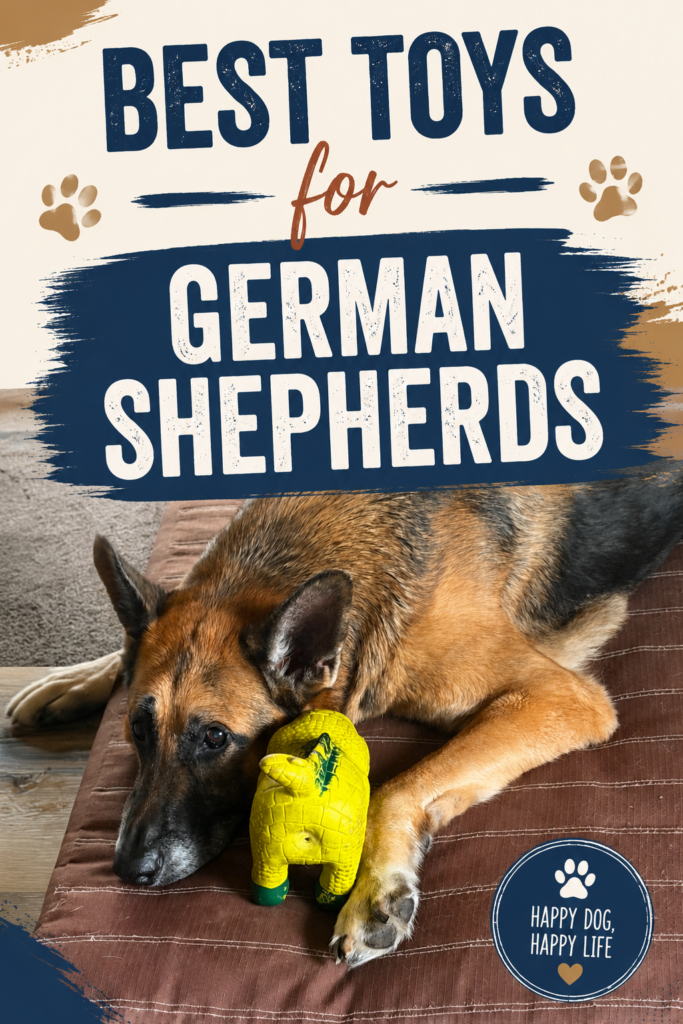
Zeus has destroyed more “indestructible” toys than I can count. Squeakers gutted in four minutes, plush turned to confetti, a “tough” ball reduced to rubber crumbs by dinnertime. After a decade of trial and error with him, I’ve learned that finding the best toys for German Shepherds isn’t about the loudest marketing claim — it’s about matching the toy to the dog in front of you. And when your dog crosses into his senior years like mine has, the whole game changes.
German Shepherds are strong, smart, and endlessly busy, which is exactly why choosing the right toys matters so much. A bored GSD doesn’t just sulk — he redecorates. Below is everything I’ve figured out about keeping Zeus engaged, safe, and mentally sharp, from his power-chewer prime right through to the gentler days we’re in now.
Best Chew Toys for German Shepherds (Built for Power Chewers)
Let’s start with the obvious: German Shepherds are power chewers. Those jaws were built for work, and a flimsy toy doesn’t stand a chance. When people ask me about the best chew toys for German Shepherds, my first rule is always the same.
Match the toy to the chewer. Skip anything labeled for “gentle” or “average” chewers and go straight for toys rated for extreme or aggressive chewers. For Zeus, two things earned a permanent spot in the basket. A KONG Extreme — made from KONG’s toughest rubber and sized for large, powerful dogs — has outlasted every other rubber toy we’ve owned. Bonus: it’s stuffable, so it doubles as a food puzzle when I pack it with his kibble or a smear of something tasty. The second is a durable nylon chew, the kind you’d find from a maker like Nylabone, for those long, satisfying gnawing sessions.
Watch the size and the pieces. Nothing should be small enough to swallow, or capable of being chewed down into swallowable chunks. And please — no sticks, no cooked bones. They splinter, and a splinter is an emergency vet visit waiting to happen.
Puzzle Toys and Snuffle Mats: Feeding the Brain
Here’s the thing I wish someone had told me years ago: mental stimulation matters just as much as physical exercise for this breed. A tired body isn’t enough. A German Shepherd needs a tired brain, too — otherwise the chewing, digging, and barking start filling the gap. (I get into the physical side over in How Much Exercise Does a German Shepherd Need.)
Make him work for it. A puzzle/treat-dispensing toy builds real cognitive engagement, slows down fast eaters, and chews through boredom in the best way. Zeus problem-solves his way through his, and the focus it demands settles him more than a walk sometimes does.
Let his nose do the work. Snuffle mats have become my secret weapon. They’re fabric mats with folds and pockets where you hide treats, so your dog forages by scent — tapping into that powerful, natural nose-work instinct. A good snuffle mat slows down speed-eaters (which lowers the risk of choking and bloat), eases boredom and anxiety, and — this is the big one for older dogs — supports cognition, all with very low physical strain. It’s perfect for rest days.
One habit that keeps all of this working: rotate the toys. I keep half of Zeus’s toys put away and swap them every week or so. An old toy that reappears feels brand new, and novelty is what keeps that big brain interested.
How to Play With a German Shepherd (Active Games Done Right)
Chewing and puzzles are the quiet stuff. But learning how to play with a German Shepherd also means burning that famous energy in a structured way.
Use tug to teach, not just tire. Tug is fantastic for bonding and energy, as long as you set rules — a clear “take it” and “drop it” keeps the game from tipping into over-arousal. Done right, it’s cooperative, not a wrestling match.
Fetch is your friend. A durable fetch ball tough enough to survive GSD jaws is one of the simplest, best energy-burners going. Zeus in his prime would have retrieved until the sun went down.
Go easy on the high-impact stuff. Flying discs are a blast for energy burn, but disc-catching is hard on joints — all that leaping and twisting and awkward landing. I avoid it entirely for seniors and growing puppies, whose bodies just can’t absorb that repeated shock. If you’re wondering when your dog might naturally dial back the zoomies, I dug into that in When Do German Shepherds Calm Down.
Supervise the soft stuff. Squeaky and plush toys are genuinely fun, and Zeus loves a good squeaker — but they are no match for a power chewer. Stuffing and squeakers are an ingestion risk, so these are strictly supervised, session-only toys in my house. When playtime’s over, they go back up on the shelf.
Gentle Toys for Senior German Shepherds
This is the section closest to my heart right now, because Zeus is a senior these days. As German Shepherds age, their teeth and jaws get more fragile — and a hard nylon chew that was perfect at three can crack a tooth at eleven. So the toy basket has to evolve.
Soften the materials. I’ve traded the hardest chews for softer options that are kinder to aging teeth. Soft plush (supervised, always) and gentler rubber are back in rotation, while the toughest nylon has quietly retired.
Lean into low-impact enrichment. This is where licking mats and snuffle mats shine. A licking mat smeared with something Zeus loves gives him calm, focused, low-strain stimulation — it’s soothing, almost meditative, and easy on his body. And the humble snuffle mat, it turns out, specifically helps older dogs facing cognitive decline. The scent work keeps his mind engaged without asking anything of his joints.
Choose low-impact food puzzles. The same puzzle-toy principle applies, just gentler — easier challenges that reward the brain without demanding hard chewing or big movement. If you want the fuller picture on aging GSDs, I’ve gathered more over in Senior GSD Care.
Whatever their age, a couple of safety habits never change: count those treats toward the daily calories so the enrichment doesn’t quietly become a diet problem, and supervise the delicate toys — plush and snuffle mats included — then put them away after the session. And any time a health question comes up, from dental worries to weight, talk to your vet before you make a change.
Finding What Works for Your Dog
If there’s one thing a decade with Zeus has taught me, it’s that the “best” toy is the one that fits your particular dog on this particular day. A power-chewing two-year-old and a gray-muzzled senior need very different things from their toy basket — and honestly, watching Zeus shift from disc-chasing dynamo to snuffle-mat philosopher has been one of the quiet gifts of loving him this long.
Start with durability that matches his jaws, feed his brain as much as his body, and be honest about where he is in life. Get those three right, and you’ll have a happier, calmer, less destructive shepherd — and a lot more toys that actually survive the week.
Sources
Full disclosure: this post contains affiliate links, which means I may earn a small commission if you buy through them — at no extra cost to you. I only point you toward gear I’d actually put in Zeus’s toy basket.