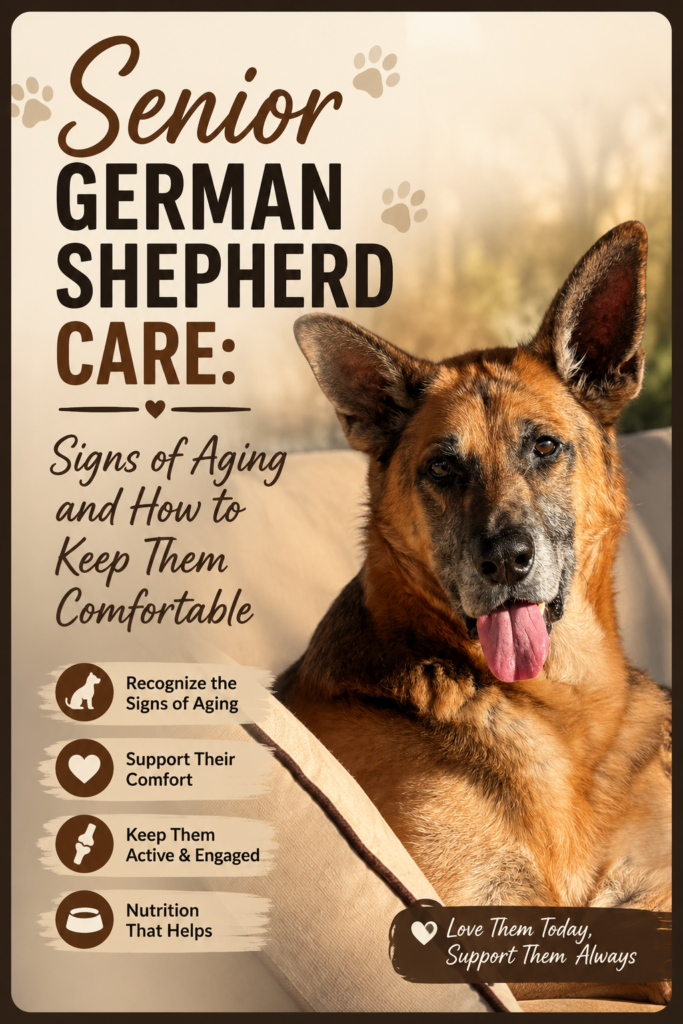
There’s a morning I keep coming back to. Zeus stood up from his bed, and for just a beat he paused — that little hitch before the back legs cooperate — and I realized my puppy had quietly become a senior German Shepherd without asking my permission. The muzzle I remember as black is dusted grey now. He sleeps deeper. He still lights up for a slow walk, but he thinks twice at the stairs. Caring for a senior German Shepherd isn’t sad, exactly. It’s tender. It’s paying closer attention, and loving them well through the part where they slow down.
If your shepherd is greying too, this is the guide I wish someone had handed me. Let’s walk through it together.
When Is a German Shepherd Actually “Senior”?
Big dogs age faster than little ones, and that catches a lot of us off guard. Large breeds like GSDs are generally considered senior around seven or eight years old — long before we’re emotionally ready for the word. Zeus didn’t look old at eight. He just needed me to shift how I cared for him.
That shift is the whole point. Around this age I stopped treating “he’s fine” as the default and started watching more closely, because the small changes matter now. (If you want the fuller picture of how these years stack up, I go deep on it in German Shepherd Lifespan.)
Signs a German Shepherd Is Getting Old
Here are the signs a German Shepherd is getting old that I’ve learned to notice — some are just time passing, some are worth a vet’s eyes.
- The greying muzzle and the extra sleep. Mostly normal. Zeus naps like it’s a competitive sport now, and that’s okay.
- Slower to rise, stiff, hesitant on stairs or jumps. This one I take seriously — hesitation before a jump or a stiff first few steps is often early arthritis, not just “getting older.”
- Weight creeping up or dropping off. Either direction is worth mentioning to your vet.
- Cloudy-looking eyes. Here’s a distinction that really matters: a bluish haze in the lens is often nuclear sclerosis, a normal aging change that doesn’t really impair vision. But cloudiness can also be cataracts, a disease that can actually blind a dog. They can look similar to us — only a vet can tell them apart, so please get eyes checked rather than guessing.
- Fading hearing and vision, dental disease, and new lumps. Have a vet check any new lump. Most are nothing; some aren’t; you can’t feel the difference from the outside.
Cognitive Decline: The “Dog Dementia” Nobody Warns You About
The change that surprised me most wasn’t in Zeus’s joints — it was the night he stood in the corner of a room he’s known his whole life, a little lost. Canine cognitive dysfunction, sometimes called dog dementia, is real, and it creeps in quietly.
Vets use the checklist DISHAA to spot it:
- Disorientation — getting stuck, looking lost in familiar places
- Interaction changes — clingier than usual, or oddly withdrawn
- Sleep-wake disruption — restless, pacing nights
- House-soiling and learning loss — accidents from a house-trained dog
- Activity changes — aimless wandering, less play
- Anxiety — new nervousness
It becomes more common with age — studies find roughly a quarter of dogs show a sign by eleven or twelve, and it climbs sharply by fifteen or sixteen. I don’t share that to scare you. I share it because it’s manageable with your vet’s help, and the sooner you name it, the sooner you can make their world feel steady again.
The Bigger Breed Issues to Know (and Watch For)
A few things run in our breed, and knowing the signs means you act instead of wait. I’m describing what to look for — not treating anything at home. That’s your vet’s call.
Osteoarthritis is very common in aging shepherds, often tracing back to hip or elbow dysplasia. Stiffness, slowing down, that hesitation before jumping — those are the signs to bring in.
Degenerative myelopathy (DM) is one GSD owners should know by name, because German Shepherds are the most affected breed. It’s a painless, progressive weakening of the hind end — the back legs stop cooperating, but it doesn’t hurt them. There’s no cure, and it’s managed with supportive care and physio. If your shepherd’s rear starts going wobbly, ask your vet about it.
Bloat (GDV) is the one I want burned into your memory, because it’s a life-threatening emergency and minutes count. The signs: unproductive retching (trying to vomit with nothing coming up), a swollen or distended belly, and restless pacing. If you see that combination, don’t wait and see — get to an emergency vet immediately. This is not a “call in the morning” situation.
How I Keep Zeus Comfortable
This is the part I love, because so much of it is within our hands. Here’s what actually makes Zeus’s days softer.
Keep them lean — this is the single biggest thing you can do. Vets will tell you weight management often helps aging joints more than any supplement. Every extra pound is load on hips and knees that are already tired. Zeus stays trim, and I can see the difference in how he moves. (If you’re rethinking his routine, How Much Exercise Does a German Shepherd Need pairs with this — gentler, but still moving.)
Give them a real bed and keep them warm. A supportive orthopedic dog bed with memory foam takes pressure off sore joints, and warmth matters because cold makes stiffness worse. Zeus’s bed lives away from drafts, and on chilly mornings he’s noticeably looser for it.
Fix the floors and spare the jumps. Slick floors are terrifying for a stiff old dog — a slip can set them back for days. I put down non-slip rugs/traction on the slick floors to give him confident footing, and a dog ramp for the car and couch so he isn’t launching those joints off the ground anymore. Traction and ramps are small changes that protect a lot.
Ask your vet about joint support. I give Zeus a combined omega-3 & glucosamine joint supplement — omega-3 fish oil has the best evidence behind it, with glucosamine and chondroitin as added support. I want to be honest here: these may help manage the aches, but they are support, not a cure, and supplements aren’t tightly regulated — so look for a trusted brand and check with your vet before starting anything. What helps Zeus may not be right for your dog.
Feed for this stage of life. A senior dog food suits their changing needs, and if teeth or gums are bothering them, softening the food helps them eat without pain. Keep water easy to reach and keep them hydrated — old kidneys and old joints both appreciate it. (Worth knowing what to keep out of the bowl too: What German Shepherds Can't Eat.)
Double up on vet visits and keep the mind busy. I take Zeus for senior check-ups twice a year now, because things move faster at this age and catching them early changes everything. Stay on top of dental care, and keep his mind engaged with gentle enrichment — sniffy walks, easy puzzles, a little of the play he still loves. And yes, the shedding doesn’t retire when they do — Why German Shepherds Shed So Much still very much applies. If anything, these are the calmest, most settled years of their lives — the quiet payoff I wrote about in When Do German Shepherds Calm Down.
A Gentle Word on Quality of Life
I’ll say this softly, because it deserves to be said softly. There may come a season where you’re weighing hard questions, and I don’t want that to blindside you. Vets have quality-of-life checklists that help owners see clearly on days that feel foggy — good days versus hard days, comfort, appetite, joy. If you ever get there, lean on them.
And know this: any hard decision belongs to you and your vet, together, in your own time. No one else gets a vote. For now, most of us are just here — loving a greying dog through his slower years, and getting to.
Loving the Grey
Zeus is asleep on his bed as I finish this, back legs twitching through some younger version of himself, chasing something in a dream. He’s not the dog who used to clear the couch in one bound. He’s better, honestly — softer, more grateful, more mine. Caring for a senior German Shepherd is just love that pays closer attention. Get the vet on your team, make their world comfortable and safe, and don’t miss a single grey-muzzled day of it.
They gave us their whole lives. These years are where we give it back.
Sources
- VCA Animal Hospitals: degenerative myelopathy in dogs
- VCA Animal Hospitals: bloat (gastric dilatation and volvulus)
- PetMD: When is a dog considered senior?
I write this as Zeus’s dad, not a vet — an owner sharing what these years have taught me. Please talk to your own vet about your dog; nothing here replaces that. This post also contains affiliate links, which means I may earn a small commission if you buy through them, at no extra cost to you. I only point to things I’d actually put under my own dog.