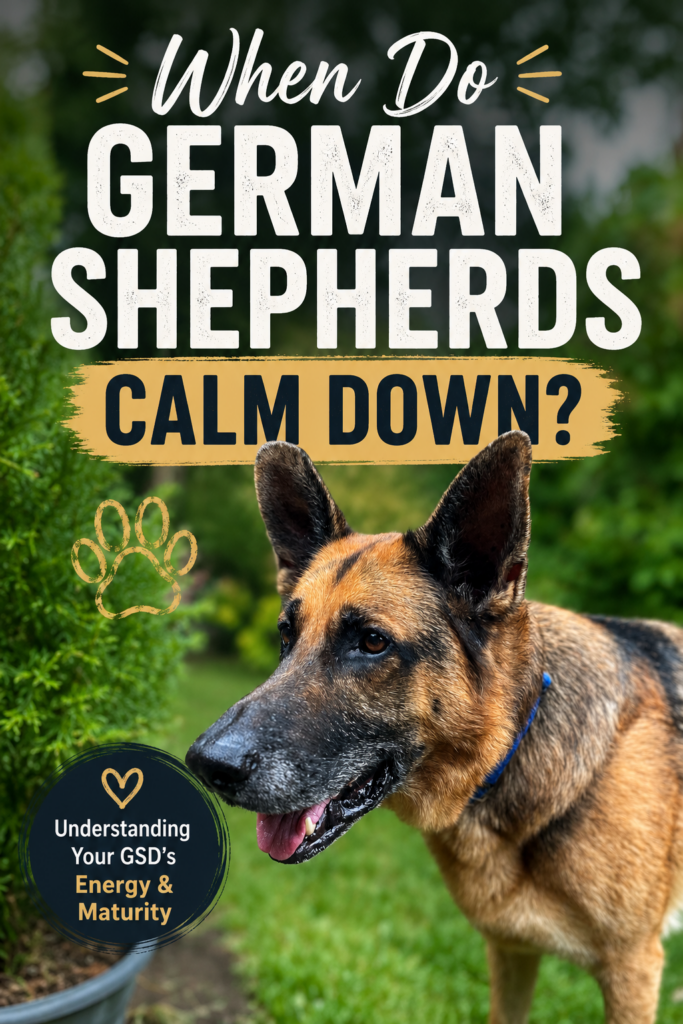
For the first two years, I genuinely wondered if Zeus would ever have an off-switch. So if you’re up at midnight typing “when do German Shepherds calm down” into your phone while your dog body-slams the couch, I’ve been exactly where you are. The honest answer is that most German Shepherds start to settle somewhere around 2 to 3 years old — but there’s no magic birthday, and I want to walk you through why.
Here’s the thing nobody told me early on: a German Shepherd’s “calm” isn’t a switch that flips overnight. It’s a slow slide that plays out over years, shaped as much by exercise and training as by age. Let me break it down the way I wish someone had broken it down for me.
What Age Do German Shepherds Calm Down? The Rough Timeline
German Shepherds are slow-maturing, large-breed dogs — they grow up later than a lot of other breeds — so patience is part of the deal. Here’s the general energy trajectory, understanding that every dog is different:
- 5 to 12 months — peak chaos. This is the hyperactive puppy-teenager phase. Short attention span, basically zero impulse control, and a body that’s growing faster than the brain steering it. Zeus at eight months could not have been more of a menace if he’d tried.
- Around 2 to 3 years — the settling begins. This is where most owners notice a real shift. The frantic edge softens. Full mental and emotional maturity tends to land around age 3.
- 2 to 6 years — calmer, but still spicy. Your dog is now an adult, but “calm for a GSD” is still higher-energy than your average couch-dwelling dog. Don’t expect a lazy Labrador.
- 7 to 8+ years — senior slow-down. This is where I’ve watched Zeus land. He’s still active and still wants his walks, but he rests more, tires faster, and picks his moments.
I’ll be straight with you: there is no single agreed-upon “calm down age” for this breed, and anyone who gives you a hard number is oversimplifying. Think of these as averages, not promises. Some Shepherds don’t visibly settle until they’re 7 or 8.
Why German Shepherd Energy by Age Varies So Much
If your friend’s GSD chilled out at two and yours is still a tornado at four, you’re not doing anything wrong. A few big factors move the needle:
Breeding line matters more than most people realize. Working-line German Shepherds are bred for drive and stamina — they tend to run hotter than show or companion lines. If your dog comes from working stock, “calm” may simply arrive later and look a little more energetic.
Under-exercised looks exactly like hyperactive. This one took me too long to learn. A GSD that doesn’t get enough physical outlet doesn’t act tired — it acts wired. A lot of what people label “crazy” behavior is really just pent-up energy with nowhere to go. If you want to get the daily numbers right, I dug into that here: How Much Exercise Does a German Shepherd Need.
Boredom reads as restlessness. These are smart, job-oriented dogs. Without something to think about, they’ll invent their own entertainment — usually something you’d rather they didn’t.
Early training and socialization build a calmer adult. The window before roughly 16 weeks is precious. The groundwork you lay there — gentle exposure, basic manners, teaching a puppy that the world is normal — tends to pay off in a more settled grown dog down the road.
The Neutering Myth (Read This Before You Book Surgery)
I hear this one constantly: “Just neuter him and he’ll calm down.” I want to hedge carefully here, because it’s a contested topic and I’m not a vet — but the evidence I’ve come across doesn’t support neutering as a reliable calm-down button.
Neutering can reduce specific hormone-driven behaviors like roaming and marking. What it generally does not do is lower your dog’s overall energy or playfulness. When people swear their dog “calmed down after being fixed,” what’s often really happening is a metabolic slowdown and some weight gain — a heavier dog moves less — or it’s simply coincidental aging that would’ve happened anyway. That’s a real distinction. If you’re weighing the surgery, talk it through with your vet for the actual health reasons, not as a behavior fix.
How to Help Your German Shepherd Settle Down
Age does a lot of the work, but you’re not just waiting around. These are the things that genuinely moved the needle with Zeus:
Meet the physical exercise need first — every day. A tired GSD is a calmer GSD. This is the foundation, and skipping it undermines everything else.
Exercise the body AND the brain. Mental work tires these dogs out in a way a walk alone can’t. Puzzle feeders, scent games, training sessions, or giving your dog an actual “job” all count. A puzzle/treat-dispensing toy became my quiet-evening secret weapon — Zeus works a food puzzle for twenty minutes and then flops. If you want ideas, I rounded up favorites here: The Best Toys for German Shepherds.
Keep a predictable routine. Dogs relax when they know what’s coming. Consistent walk, meal, and rest times give an anxious brain fewer reasons to stay switched on.
Teach a real off-switch with crate or “place” training. Calm is a skill you can train, not just a mood you wait for. Teaching Zeus to go to a spot and stay settled — a comfortable calming or orthopedic dog bed gave him a defined place to actually relax — taught him that downtime is a normal part of the day. To be clear, no bed or toy fixes a wound-up dog on its own; they’re tools that support the training you’re doing.
Reward the calm, not the chaos. This is the one I got backwards for months. When your dog is finally lying quietly, that’s the moment to calmly praise — not ignore. And try not to accidentally reward the wired behavior with big excited attention, because to a GSD, any attention is a win.
What About Senior Shepherds?
Watching Zeus cross into his senior years has been its own kind of gift. The natural slow-down is real — he sleeps deeper, warms up slower, and no longer feels the need to supervise every single thing I do. But “calmer” doesn’t mean “checked out.” He still lights up for a scent game and still wants to be part of the day. Mental engagement matters just as much now as it did at two — it’s just quieter. If you’ve got an older dog, I put together everything I’ve learned here: Senior GSD Care.
The Honest Takeaway
So — when do German Shepherds calm down? Most start settling around 2 to 3, reach real maturity near 3, and keep mellowing into their senior years, with a whole lot of individual variation in between. If your young dog is still a handful, you’re not failing and neither is your dog. You’re just early in a long, rewarding curve.
Meet the exercise need, feed the brain, stay consistent, and reward the quiet moments. The calm comes. Zeus is proof — my former couch-destroyer now spends most evenings snoring at my feet, and I’d be lying if I said I didn’t miss a little of that puppy chaos. Hang in there. Your calm dog is in there, growing up right on schedule.
Sources
(Heads up: this post contains a few affiliate links. If you buy through one, I may earn a small commission at no extra cost to you — it helps keep Zeus in puzzle toys.)