
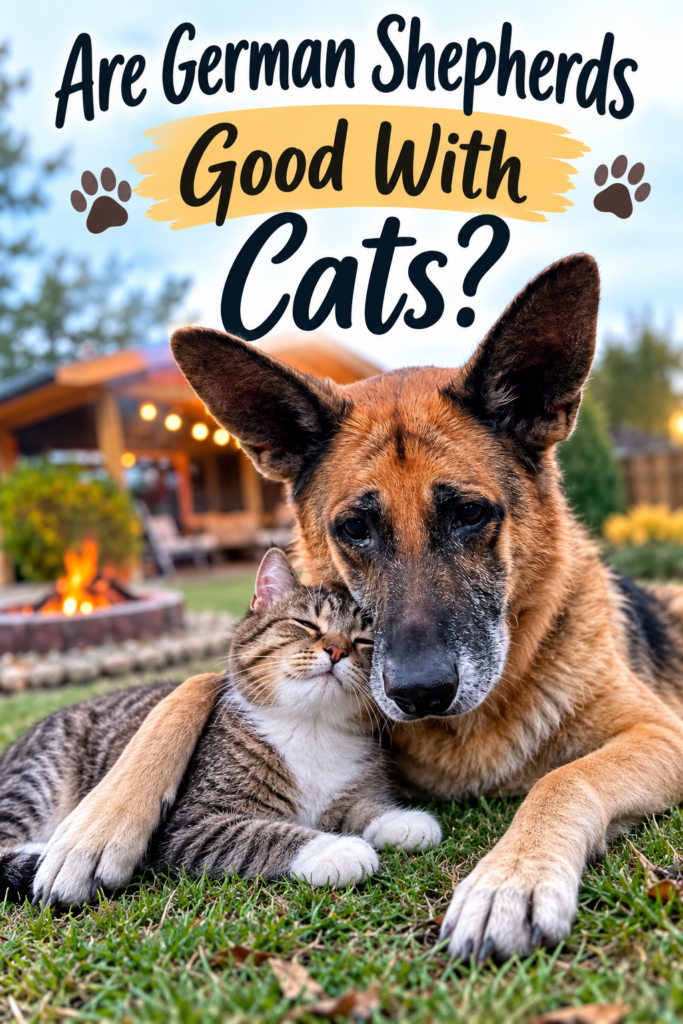
The first time Zeus met a cat, I held my breath. He was a big, confident senior German Shepherd, and the cat was a small, unimpressed neighbor’s tabby who clearly ran her own household. I wanted to know the same thing you probably do: are German Shepherds good with cats, or was I about to referee a disaster? The honest answer surprised me, and it’s the reason I wrote this.
So let me give you the real answer up front, before the tips: it depends on the individual dog. Not the breed. The dog.
Are German Shepherds Good With Cats? The Honest Answer
I wish I could hand you a clean yes or no, but German Shepherds and cats don’t work that way. What matters far more than the breed label is the specific dog in front of you — his prey drive, his socialization history, and his temperament.
Plenty of GSDs live peacefully with cats. I’ve seen them nap on the same couch, share the same sunbeam, even groom each other. But a dog with high prey drive — the kind that lunges after squirrels or chases anything small and fast — is a higher-risk situation and needs slower, more careful work. That instinct is hardwired, and no amount of wishing makes it vanish.
A few things stack the odds in your favor. Younger dogs and younger cats tend to adapt more easily. Animals raised together from the start often just accept each other as normal. An older, set-in-his-ways dog meeting a brand-new cat is a bigger ask — though as I learned with Zeus, it’s absolutely still possible with patience.
If you’re curious how age and maturity factor in, I get into it more in When Do German Shepherds Calm Down — a calmer, older dog is often an easier introduction than a wired adolescent.
German Shepherds and Cats: Why Temperament Beats Breed
Here’s the thing people miss when they ask about German Shepherds and cats. They’re looking at the breed’s reputation — protective, intense, working-line energy — and trying to predict one specific relationship from it. It doesn’t work.
Zeus, for example, is deeply gentle with anything he’s decided belongs to his family. But he’ll fixate on a rabbit in the yard in a heartbeat. Same dog, two completely different instincts, depending on whether the small animal reads as “family” or “prey.” Your job during an introduction is to help the dog file the cat under “family.”
Socialization does a lot of that heavy lifting. A GSD who grew up around cats, or around calm small animals in general, comes to the table with a head start. One who never has is learning a brand-new category from scratch — and that’s fine, it just means you go slower.
If you want more on how varied this breed really is, 25 Fun Facts About German Shepherds is a fun rabbit hole. But the short version stands: temperament beats breed, every time.
Introducing a German Shepherd to a Cat: Step by Step
This is the part I get asked about most, so here’s the exact process I’d use — the same careful, boring, works-because-it’s-boring approach. Do not skip steps to save time. Going slow is the shortcut.
-
Keep them fully separate at first. Give the cat its own secure space where the dog can’t get to it. No face-to-face anything yet. They just coexist in the same house behind a closed door. A sturdy tall baby/pet gate is your best friend here — I want a real physical barrier, not the honor system.
-
Do a scent swap. Trade bedding, towels, or a worn sock between them so each animal learns the other’s smell before they ever see each other. Reward calm sniffing on both sides. Scent is how they build the first draft of “who is this.”
-
Allow controlled visual contact through a barrier. Let them see each other through a baby gate, a cracked door, or a screen door — in short sessions at first, gradually longer. Reward calm behavior every time. If either one loses it, you’ve gone too fast; back up a step.
-
Move to leashed, controlled face-to-face meetings. Dog on leash, under obedience control, cat free to move. Keep sessions short and end them while things are still going well. Reward calm. This is where good treats earn their keep — I keep high-value training treats in my pocket so I can mark and pay for every calm glance instead of a stare.
-
Grant gradual, supervised freedom. Only after consistent calm behavior across many sessions. Increase their time together slowly, and stay present for all of it. “Supervised” is doing a lot of work in that sentence.
-
Always give the cat safe retreats. The cat needs vertical escape routes and high perches, plus a dog-free room stocked with food, water, and litter. A good cat tree with high perches lets the cat get up and out of reach on her own terms, which lowers everyone’s stress. A cat who knows she can escape is a calmer cat.
-
Use positive reinforcement throughout, and never force it. Go at the more nervous animal’s pace, not your timeline. And stay calm yourself — dogs read your emotional state, so if you’re tense on the leash, your GSD feels it and assumes there’s something to be tense about.
That’s it. It’s not complicated. It’s just slow, and slow is the whole point.
Managing a High Prey Drive GSD
If your German Shepherd has a strong prey drive, you’re not out of the running — you just need a bigger toolbox and a longer timeline.
Build rock-solid obedience first. A reliable “leave it,” a solid recall, and a dependable “place” or stay give you real off-ramps when the dog locks on. I’d want these fluent before the cat is ever loose in the room.
Train impulse control on purpose. Drills that teach the dog to wait, to look away from something exciting, to choose you over the trigger — those pay off directly here.
Manage the environment hard. Keep the dog leashed indoors during the early phases, use physical barriers, and never leave a high-drive dog unsupervised with the cat. Not “probably fine” unsupervised — never.
And be realistic with yourself. Some GSDs will only ever tolerate a cat rather than befriend one, and that’s a perfectly good outcome. A few high-prey-drive dogs may never be genuinely safe around cats, and honoring that is part of loving them responsibly. A well-exercised dog is easier to work with too, which is why I keep How Much Exercise Does a German Shepherd Need handy — a tired dog has less energy to obsess.
To be clear: no gate, treat, or training plan guarantees safety. These tools lower risk and buy you time to read the situation. Your supervision is the real safeguard.
Signs It’s Not Working (Stop and Get Help)
Watch for these, and if you see them, stop the introductions and call in a professional trainer or behaviorist:
- Fixation or stalking, hard staring, intense chasing
- Lunging or snapping at the cat
- A cat who’s chronically hiding, not eating, or clearly panicked
None of that is something to push through or hope out of. It’s a signal that the current pace isn’t working, and a good pro can often get you unstuck safely.
Where Zeus and the Tabby Landed
They never became cuddle buddies, if I’m honest. But Zeus learned to share a room with that unimpressed tabby, to look away from her on cue, and to treat her as furniture with opinions rather than prey. For an older dog meeting a bold new cat, that’s a win I’ll happily take.
So — are German Shepherds good with cats? Some are, some can learn to be, and a few never will. Your dog will tell you which one he is if you go slow enough to listen. Take your time, keep the cat’s escape routes open, and let calm be the thing you reward most. You’ve got this.
Sources
- American Kennel Club: German Shepherd Dog breed information (temperament)
- ASPCA: introducing your dog to a new cat
(Quick note: some links below are affiliate links, and if you buy through them I may earn a small commission at no extra cost to you. I only point to gear I’d actually use with Zeus.)